detect_ar() and fastcpd.ar() are
wrapper functions of detect() to find change points in
AR(\(p\)) models. The function is similar to detect() except that
the data is by default a one-column matrix or univariate vector
and thus a formula is not required here.
Usage
detect_ar(data, order = 0, ...)

fastcpd_ar(data, order = 0, ...)

fastcpd.ar(data, order = 0, ...)
Arguments
- data
A numeric vector, a matrix, a data frame or a time series object.
- order
A positive integer specifying the order of the AR model.
- ...
Other arguments passed to
detect(), for example,segment_count.
Value
A fastcpd object.
Examples
set.seed(1)
n <- 1000
x <- rep(0, n + 3)
for (i in 1:600) {
x[i + 3] <- 0.6 * x[i + 2] - 0.2 * x[i + 1] + 0.1 * x[i] + rnorm(1, 0, 3)
}
for (i in 601:1000) {
x[i + 3] <- 0.3 * x[i + 2] + 0.4 * x[i + 1] + 0.2 * x[i] + rnorm(1, 0, 3)
}
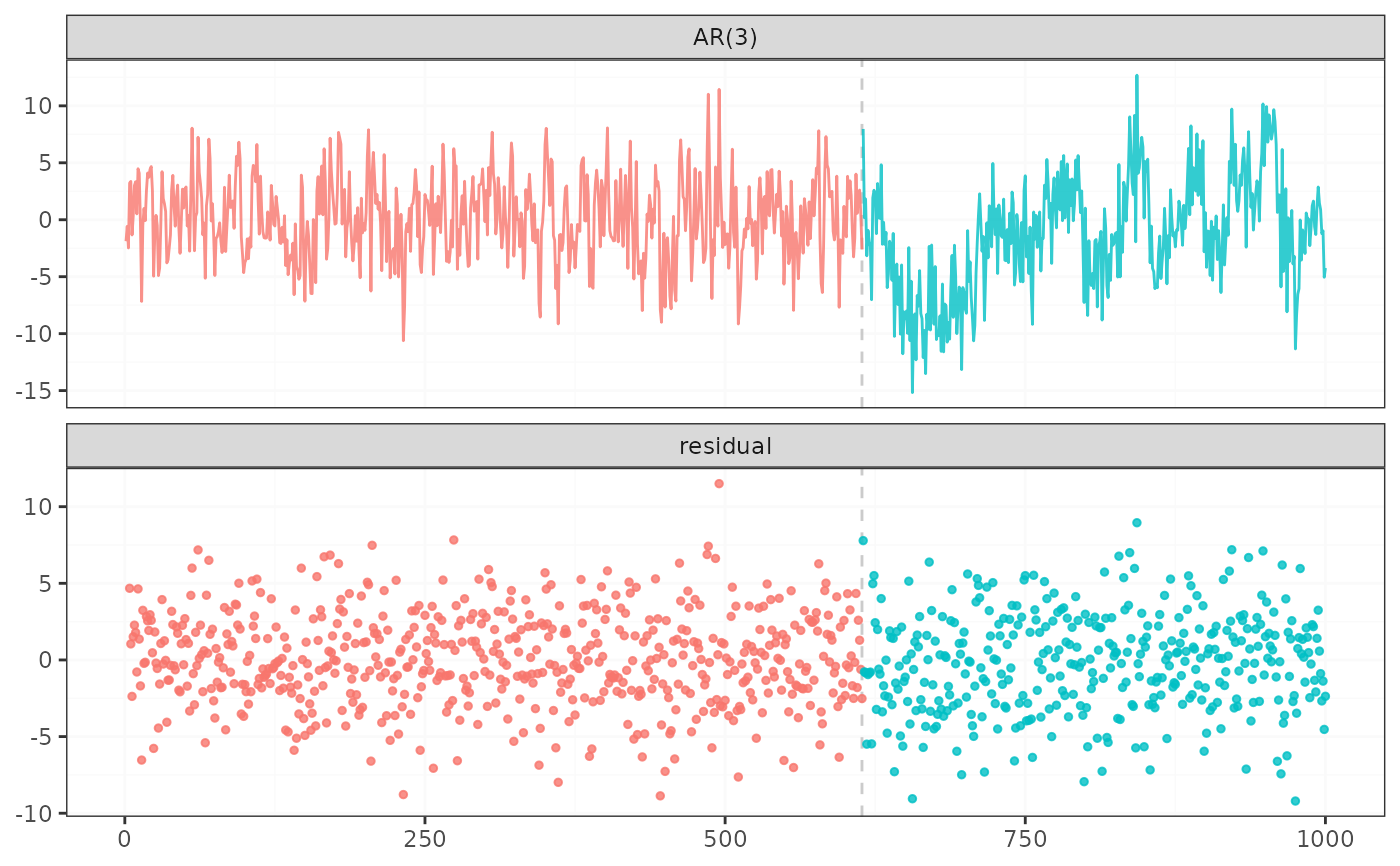
result <- detect_ar(x[3 + seq_len(n)], 3)
summary(result)
#>
#> Call:
#> detect_ar(data = x[3 + seq_len(n)], order = 3)
#>
#> Change points:
#> 614
#>
#> Cost values:
#> 2754.116 2038.945
#>
#> Parameters:
#> segment 1 segment 2
#> 1 0.57120256 0.2371809
#> 2 -0.20985108 0.4031244
#> 3 0.08221978 0.2290323
plot(result)
 set.seed(1)
n <- 1000
x <- rep(0, n + 3)
for (i in 1:600) {
x[i + 3] <- 0.6 * x[i + 2] - 0.2 * x[i + 1] + 0.1 * x[i] + rnorm(1, 0, 3)
}
for (i in 601:1000) {
x[i + 3] <- 0.3 * x[i + 2] + 0.4 * x[i + 1] + 0.2 * x[i] + rnorm(1, 0, 3)
}
result <-
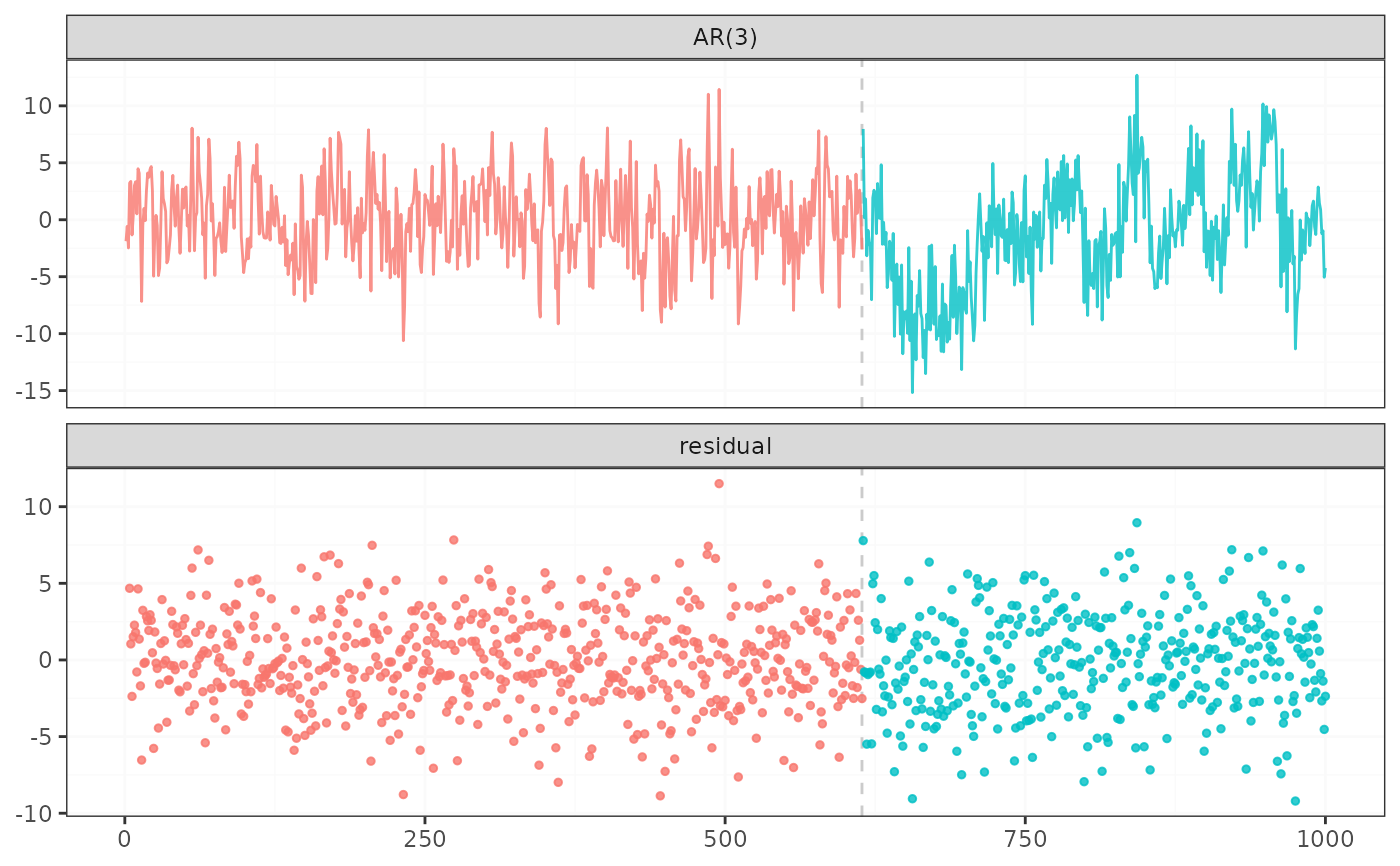
detect_ar(x[3 + seq_len(n)], 3, beta = "MDL", cost_adjustment = "MDL")
summary(result)
#>
#> Call:
#> detect_ar(data = x[3 + seq_len(n)], order = 3, beta = "MDL",
#> cost_adjustment = "MDL")
#>
#> Change points:
#> 614
#>
#> Cost values:
#> 3973.35 2941.576
#>
#> Parameters:
#> segment 1 segment 2
#> 1 0.57120256 0.2371809
#> 2 -0.20985108 0.4031244
#> 3 0.08221978 0.2290323
plot(result)
set.seed(1)
n <- 1000
x <- rep(0, n + 3)
for (i in 1:600) {
x[i + 3] <- 0.6 * x[i + 2] - 0.2 * x[i + 1] + 0.1 * x[i] + rnorm(1, 0, 3)
}
for (i in 601:1000) {
x[i + 3] <- 0.3 * x[i + 2] + 0.4 * x[i + 1] + 0.2 * x[i] + rnorm(1, 0, 3)
}
result <-
detect_ar(x[3 + seq_len(n)], 3, beta = "MDL", cost_adjustment = "MDL")
summary(result)
#>
#> Call:
#> detect_ar(data = x[3 + seq_len(n)], order = 3, beta = "MDL",
#> cost_adjustment = "MDL")
#>
#> Change points:
#> 614
#>
#> Cost values:
#> 3973.35 2941.576
#>
#> Parameters:
#> segment 1 segment 2
#> 1 0.57120256 0.2371809
#> 2 -0.20985108 0.4031244
#> 3 0.08221978 0.2290323
plot(result)